- What to Integrate: Channels and Systems That Must Talk
- Core Stack Components for MENA FMCG Brands
- The Goal: Unified View of the Shopper
- Identity & Consent in MENA: Cookieless, Mobile-First, Privacy-Conscious
- Why Identity Is Complex in MENA
- Consent is Gaining Relevance
- Smart Identity Strategies
- 1. Collect First-Party IDs
- 2. Leverage App Logins and Loyalty Cards
- 3. Use Permissioned Channels
- 4. Unify Identities with a CDP or Identity Graph
- Activation: Where Integration Pays Off
- Smarter Targeting, Not Just Retargeting
- Retail Media + Owned Data
- Advanced Tactics
- Your Analytics Stack: From Clicks to Lifetime Value
- Foundational Stack for FMCG in MENA
- Key Layers
- Case KPI Tree: Awareness to Sales to Loyalty
- Sample KPI Tree for a Regional Campaign
- Awareness: Impressions & Video Views
- Engagement: Click-Through Rate (CTR) & Time on Page
- Consideration : Add-to-Cart & Coupon Downloads
- Purchase: Revenue & Customer Acquisition Cost (CAC)
- Loyalty: LTV, Repeat Purchase Rate & Churn
- Align KPIs With Business Impact
- How Lamana Builds Data-Driven Campaign Foundations
- Our Integration Blueprint
- Regional Tooling Expertise
- Sample Result
- Integration Is the Real Performance Multiplier
Across the FMCG markets of the UAE, Saudi Arabia, Egypt, and beyond, bold creative and big budgets can help your campaign stand out, but that alone doesn’t guarantee success. Many 360° campaigns look impressive on presentation decks but fail to deliver in the real world. Why? Because the underlying marketing data, from media and web to CRM and retail, isn’t properly connected, activated, or measured. Most brands still lack a connected marketing data stack MENA that ties together web, media, CRM, and retail data.
True ROI comes from connecting your ecosystem. When Meta audiences sync with your CRM, when Carrefour POS data informs your retargeting, and when GA4 funnels tie back to lifetime value (LTV. That is when performance compounds.
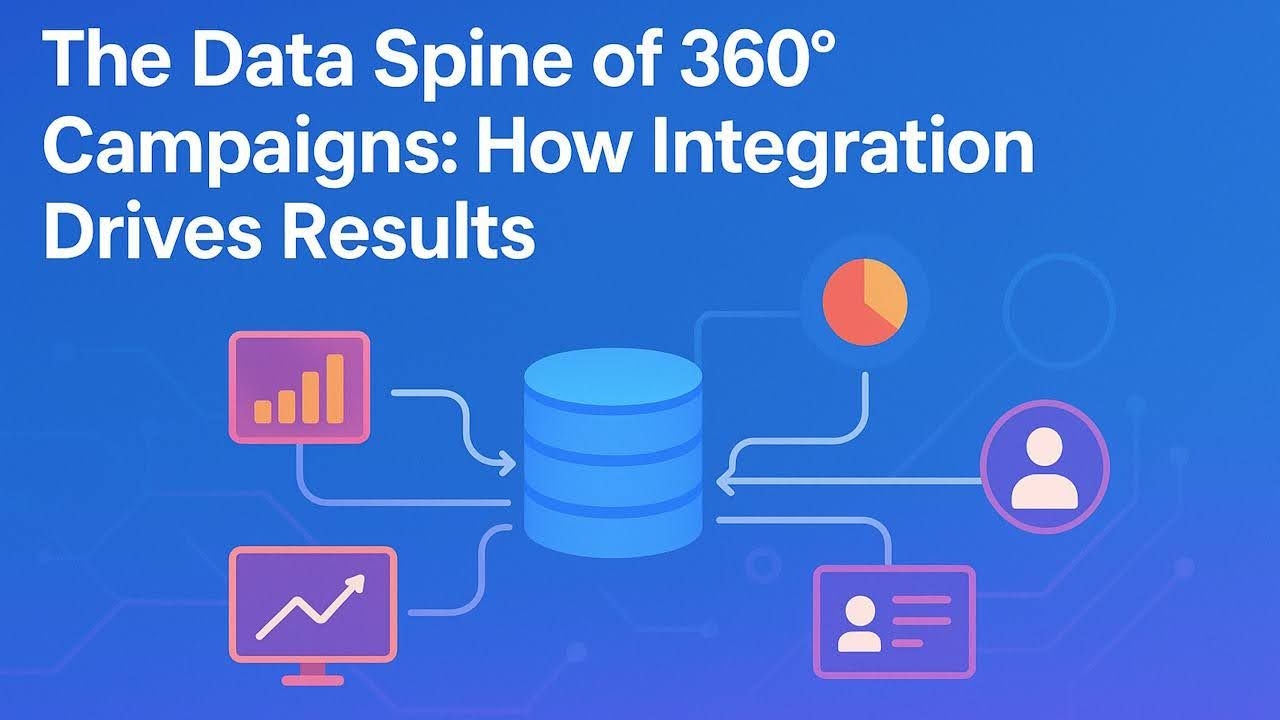
This article explores the systems, strategies, and metrics that help turn disconnected channels into a unified, high-performing marketing engine.
What to Integrate: Channels and Systems That Must Talk
MENA FMCG brands need a connected tech stack that brings all ad, analytics, commerce, and retail systems together.
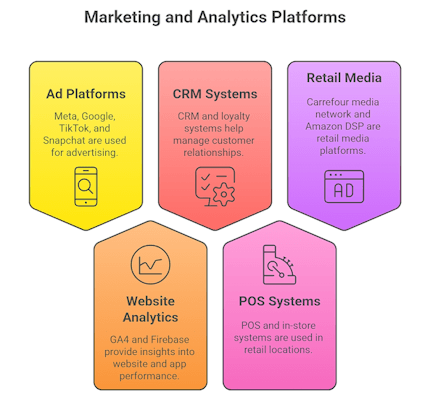
Core Stack Components for MENA FMCG Brands
This part outlines the key technology systems FMCG brands in the Middle East need to connect. It shows how ad platforms, analytics, CRM, POS, and retail media should work together to track shoppers, personalize messages, and measure results.
- Ad Platforms: Meta, Google, TikTok, and Snapchat campaigns should feed data into your analytics or CRM. Google now allows importing Meta and TikTok cost data into GA4, giving marketers a unified view of ad spend and ROI.
- Web & App Analytics: Use GA4 (and Firebase for mobile apps) to track user behavior across web and app. GA4’s “App+Web” model gives a single view of the shopper journey across devices and touchpoints.
- CRM & Loyalty Systems: Your customer and loyalty databases must link to e-commerce, POS, and marketing tools so each shopper has a single profile. By syncing loyalty IDs and CRM data, you can personalize promotions and track repeat purchases.
- POS & In-Store Systems: Integrate retail data from partners like Carrefour, Lulu, and Panda. When a shopper buys your product in-store or through a retailer app, that data should flow into your analytics or CDP.
Retail Media Platforms: Connect to retailer networks such as Carrefour Media Network and Amazon DSP. These platforms let you run ads directly where shoppers buy. Make sure the performance data - impressions, clicks, and attributed sales - feeds back into your analytics stack for unified measurement.
The Goal: Unified View of the Shopper
Once all signals merge into one shopper ID, audience segmentation MENA becomes smarter, allowing precise, localized targeting. When a shopper’s identity is consistent across channels, brands unlock stronger targeting, personalization, and attribution.
As Amazon Web Services explains, a unified customer view “consolidates and connects all the disparate signals from every customer interaction across touchpoints and data sources.” This includes purchases, loyalty memberships, app sessions, and even in-store support calls.
Key benefits of a unified view:
- One Identity Across Channels: Centralizing data, often via a Customer Data Platform (CDP) or CRM, ensures that in-store purchases and online actions belong to one customer record. According to Omniful, brands without unified data often face “duplicate customer records” and “inconsistent loyalty experiences.” With a single ID, you can deliver consistent personalization, like identifying that someone watched your TikTok ad and later redeemed loyalty points through your app.
- Cross-Channel Attribution: Integrated data enables full visibility of the customer journey. Google Analytics 4 documentation shows that unified analytics help marketers see “how many users start on an app and then visit a website to complete a purchase.” Similarly, GulfBusiness highlights that closed-loop measurement, which means linking ad impressions to real sales, is becoming essential for FMCG performance in omnichannel environments.
- Smarter Targeting and Insights: When all data lives in one place, segmentation becomes sharper and insights more actionable. TLC report notes that organizations integrating first-party data from multiple sources achieve “higher ROI and stronger customer retention.” For example, if your unified profile shows a shopper who often engages on Facebook but completes purchases at Lulu, you can tailor your campaigns accordingly, targeting ads and loyalty rewards where they have the most impact.
Identity & Consent in MENA: Cookieless, Mobile-First, Privacy-Conscious
This section explores how MENA’s mobile-first shoppers and evolving privacy laws are reshaping identity and consent.
Why Identity Is Complex in MENA
The MENA region presents unique identity challenges for FMCG marketers. Shoppers here are mobile-first, multilingual, and highly cross-channel in behavior, all of which make it difficult to build a single, persistent customer view.
Recent studies show that 67% of UAE consumers made their most recent purchase via smartphone, a trend mirrored in Saudi Arabia, where mobile accounts for roughly two-thirds of e-commerce transactions. Time of India states that 53% of UAE shoppers already use (or want) cross-channel shopping features, reflecting fluid app↔browser switching.
Language adds another layer of complexity. A recent study found that 65% of users prefer digital content in their native language: Arabic, English, or both (e-Arabization). For marketers, this means identity graphs must accommodate multilingual profiles, localized interfaces, and culturally adaptive content.
Consent is Gaining Relevance
Across the Middle East, privacy and data protection are becoming central to marketing strategy. New regional laws now make explicit consent a legal requirement rather than a best practice.
In the UAE, the Personal Data Protection Law (PDPL), first enacted in 2020 and reinforced by the 2024 Telemarketing Regulations, mandates that all marketing communications, including email, SMS, calls, and online behavioral advertising, require prior opt-in from the user. As the UAE ResourceHub clarifies, there is no implied consent under PDPL; even existing customers must actively agree before receiving promotional content.
Saudi Arabia’s PDPL, which took full effect in September 2023, follows a GDPR-style framework. According to Saudi Data and Artificial Intelligence Authority (SDAIA), businesses must obtain user consent before processing personal data for marketing purposes. Individuals also have the right to withdraw consent or object to marketing activities at any time, rights that brands must honor immediately.
Key principles for compliance and trust:
- Mandatory opt-in for marketing: Both UAE and KSA PDPLs require explicit consent before any email, SMS, phone, or social media marketing occurs. There is no lawful basis for marketing without prior approval.
- Easy opt-out: Users must be able to unsubscribe at any time. Clear links, SMS commands, or one-click preferences are required under both laws.
- Telemarketing registration: Under the UAE’s 2024 Telemarketing Regulations, all cold-calling or SMS campaigns must be registered, and “Do Not Call” preferences must be respected.
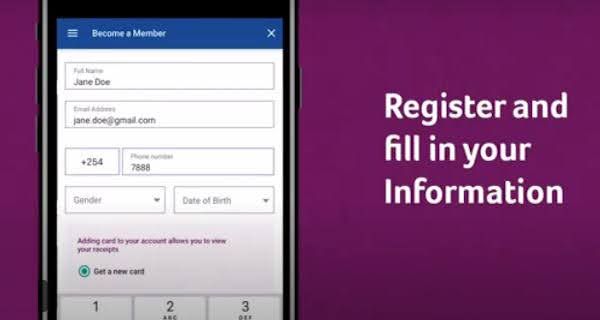
- Consent in loyalty and CRM flows: Even when collecting data for loyalty programs or CRM campaigns, consent must be clearly separated. For example, a Carrefour or Lulu loyalty signup should include a dedicated checkbox explaining how customer data will be used for promotional messages.
Smart Identity Strategies
In cookieless and privacy-first landscape, marketers across the MENA region must focus on first-party identifiers, explicit consent, and unified customer profiles to sustain personalization and measurement. As eMarketer notes, “first-party data is becoming the new fuel for digital marketing,” particularly in regions with evolving data laws and mobile-driven commerce.
1. Collect First-Party IDs
Encourage customers to log in or register before completing a purchase. Capturing basic identifiers such as email addresses or phone numbers (hashed for privacy) helps connect sessions and devices. Even a “guest checkout” can include an email field for digital receipts, transforming an anonymous user into a known profile.
2. Leverage App Logins and Loyalty Cards
Mobile apps and loyalty programs are core to identity resolution in MENA. If a shopper signs into the Carrefour or Lulu app, or swipes a loyalty card at checkout, their online and offline actions immediately merge under one ID. Renascence.io reports that Carrefour’s “Carrefour Club” program links each member’s in-store and online shopping history for reward personalization.
3. Use Permissioned Channels
Messaging apps are powerful, consent-driven identity tools. In markets like the UAE and Saudi Arabia, WhatsApp and SMS remain top channels for retail engagement. Brands can invite users to opt in for updates, promotions, or coupons, creating both a marketing consent and a verified ID (the phone number itself). As Arabad explains, WhatsApp-based marketing “offers a blend of personalization and compliance,” since every opt-in doubles as a consent refresh.
4. Unify Identities with a CDP or Identity Graph
All first-party data, from web, app, CRM, and POS, should flow into a Customer Data Platform (CDP) or identity-resolution layer. This enables marketers to merge device IDs, cookie IDs, loyalty cards, and contact hashes into one unified customer view.
When Carrefour or Noon can recognize the same shopper across app, website, email, and in-store visits, they can deliver consistent experiences and more precise campaign attribution.

Activation: Where Integration Pays Off
In data activation FMCG, connecting CRM and analytics with ad platforms ensures every data point drives meaningful action. Connecting CRM, analytics, ad platforms, and retail media allows brands to target, personalize, and optimize campaigns in real time, turning data integration into measurable ROI.
Smarter Targeting, Not Just Retargeting
Build first-party audience segments using your own CRM and analytics, such as “weekly snack buyers.” Modern CDPs can unify purchase, web/app, and loyalty data to flag these micro-cohorts. For example, one case study used BigQuery with hourly updates to create segments from events, purchases, and CRM fields, then pushed them into ad platforms.
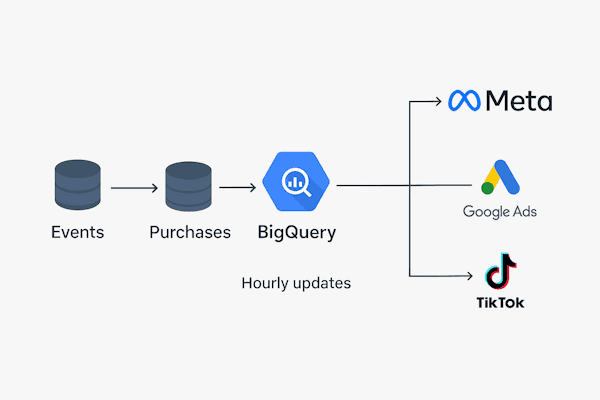
- Activate on Meta/TikTok/Google: Sync these segments into social and search campaigns. Upload customer lists (emails or phone numbers) into Meta Ads Manager as Custom Audiences or into Google Ads as Customer Match lists. TikTok Ads also supports Custom Audiences via file upload or pixel data. These integrations let you target or exclude exact first-party segments across channels.
Watch how to create a Custom Audience on TikTok using a customer file
- Precision payoffs: First-party targeting greatly increases relevance. Properly activated audiences “allow you to target with precision, personalize messaging at scale, and drive better performance.” Campaigns can deliver tailored content to weekly snack buyers or loyalty members, far more effective than generic retargeting.
Retail Media + Owned Data
Brands can overlay their own CRM data onto retailer ad networks like Carrefour and Amazon DSP to run highly personalized campaigns inside the retailer’s ecosystem, linking ad exposures directly to sales. This approach to data activation FMCG allows brands to link loyalty audiences directly with retailer ad exposure for precise ROI tracking.
Retailer-owned media: Many retailers now allow brands to overlay their CRM data on shopper bases. Carrefour Links, for example, is built on 8 billion transactions from ~80 million shoppers. Carrefour partners with tech firms like Criteo, Google, and LiveRamp so brands can run highly personalized ads inside Carrefour’s ecosystem, online or in-store.
Amazon DSP: Amazon’s DSP uses first-party shopping signals and lets advertisers upload hashed CRM lists as Custom Audiences. This allows brands to reach existing customers or lookalikes with display and video ads across Amazon properties (Prime Video, Fire TV, Alexa) and third-party exchanges, running deeply personalized campaigns.
Advanced Tactics
Use techniques like lookalike audiences, RLSA, and dynamic creative to target high-value or high-intent shoppers with personalized ads based on real purchase behavior and customer profiles.
- Lookalikes from purchase data: Create lookalike audiences from real transactions. Meta’s Lookalike Audiences can seed from high-value customers to find new users with similar traits. Google Ads can use customer lists in Performance Max or Discovery campaigns to identify new users with similar intent.
- RLSA for high intent: Google’s Remarketing Lists for Search Ads let you reconnect with users who have shown prior intent, such as site visitors or cart abandoners. Tailor bids and ad copy to increase likelihood of conversion.
- Dynamic creative via CDP: Feed profile attributes into ads. Dynamic Creative Optimization tools swap ad elements based on user data. Google Studio can use feeds to show different products or text to different segments, e.g., Product A to users 40+ and Product B to under 40. Linking CDP profile fields like preferences, past purchases, and location lets each user see a personalized ad variant without manual design.
Your Analytics Stack: From Clicks to Lifetime Value
A solid marketing data stack MENA connects every channel, from GA4 to CRM and retail, enabling a true end-to-end performance view
Foundational Stack for FMCG in MENA
In FMCG markets, a strong analytics setup collects detailed event data and links it to business outcomes. Brands typically use GA4 + BigQuery to analyze all website and app events. BigQuery can join data from multiple sources like Google Ads spend, GA4 events, and Salesforce leads. This allows you to track the full customer journey from the first click to purchase and repurchase using SQL.
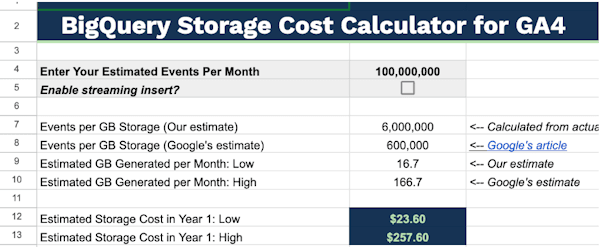
We've created a spreadsheet that you can use to estimate your Google Analytics storage costs in BigQuery (see screenshot below).
- Tagging & Tracking: Use Google Tag Manager on your website to deploy the GA4 tag. For mobile apps, GA4 is built on Firebase. Adding an app data stream automatically creates a linked Firebase project and requires installing the Firebase Analytics SDK. This ensures all user interactions, from clicks to add-to-cart events, flow consistently into GA4 and BigQuery.
- Dashboards: Connect BigQuery or GA4’s API to a BI tool like Looker Studio or Looker for reporting. These tools let marketers build custom reports and track KPIs such as conversion rates, retention, and repeat purchases without the limitations of GA4’s UI. For example, Looker Studio can merge event data with CRM revenue to calculate customer lifetime value by channel. Together, this stack captures every touchpoint from visits to purchase and repurchase, enabling accurate CLV calculations.
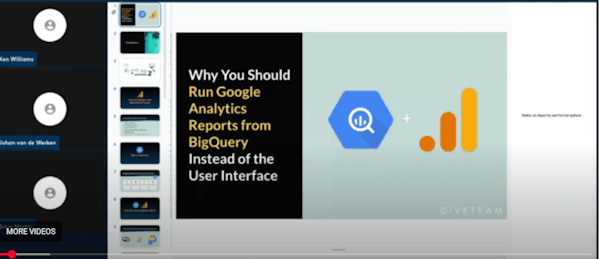
Watch the recording from a webinar
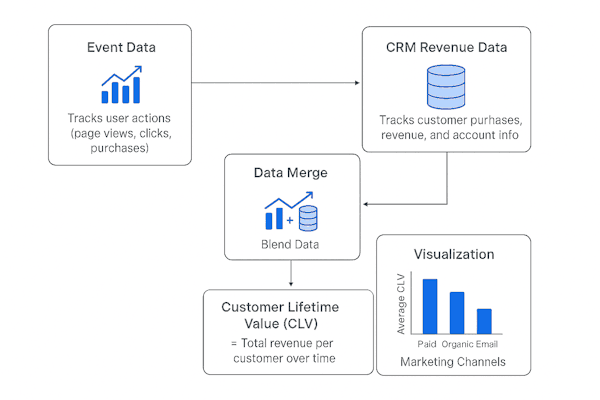
Here’s a clear way to show that example visually and conceptually:
Example: Calculating Customer Lifetime Value (CLV) by Channel in Looker Studio
Step 1: Data Sources
- Event Data: Tracks user actions (page views, clicks, purchases)
- CRM Revenue Data: Tracks customer purchases, revenue, and account info.
Step 2: Merge Data
- Use Looker Studio’s “Blend Data” feature to join the two sources.
- Join on Customer ID or Email to connect user activity with revenue.
Step 3: Define Metrics
- Customer Lifetime Value (CLV) = Total revenue per customer over time.
- By Channel: Segment CLV by acquisition channel (e.g., Paid Ads, Organic Search, Email).
Step 4: Visualization
- Create a chart showing CLV per channel:
- X-axis: Marketing Channels
- Y-axis: Average CLV
- Optional: Breakdown by cohort or time period
Step 5: Insights
- Identify which channels bring the highest lifetime value customers.
- Optimize marketing spend based on true customer value, not just immediate revenue.
Key Layers
This section explains how FMCG brands in the Middle East can measure and analyze marketing performance.
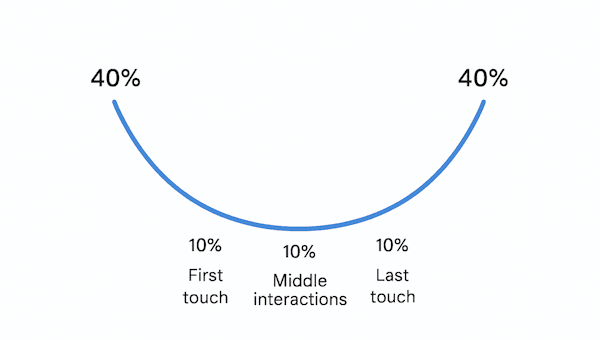
- Attribution Models: Don’t rely on just one model. GA4 defaults to last-click attribution, giving full credit to the final click, but you can apply more nuanced approaches. For example, a position-based (U-shaped) model assigns around 40% credit to the first touch and 40% to the last, splitting the remaining 20% across middle interactions. For a more holistic view, Marketing Mix Modeling (MMM) uses historical spend and sales data to statistically distribute conversions across all channels. With GA4’s BigQuery export, you can write custom rules or models beyond GA’s defaults.
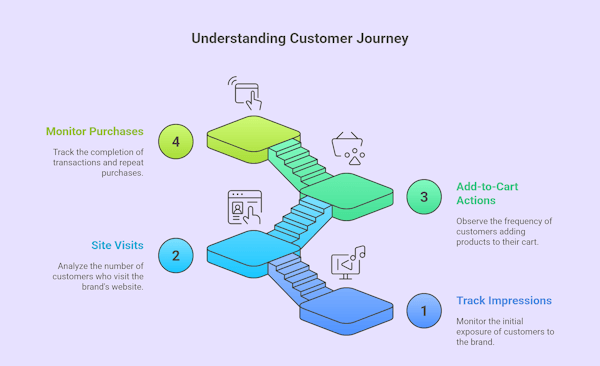
- Funnel Analysis: Break the customer journey into stages. Track impressions → site visits → add-to-cart → purchases, and even repeat purchases. GA4’s enhanced ecommerce events automatically capture many of these steps. Exporting GA4 events to BigQuery lets you build custom funnel reports or cohort analyses. You can see how many ad impressions became visits, how many visits led to cart additions, and how many turned into purchases or repeat orders.
- CRM Integration: Connect marketing to actual sales. Combine GA4 customer events in BigQuery with CRM systems like Salesforce or HubSpot to see which campaigns drove leads and deals. This allows revenue and customer lifetime value to be attributed to media spend. Dashboards can show the full journey from impressions to clicks, conversions, and closed deals, giving FMCG teams a comprehensive view of ROI.
- Sources: These recommendations are based on Google’s best practices, GA4 and BigQuery documentation, and industry guides on attribution and data integration.
Case KPI Tree: Awareness to Sales to Loyalty
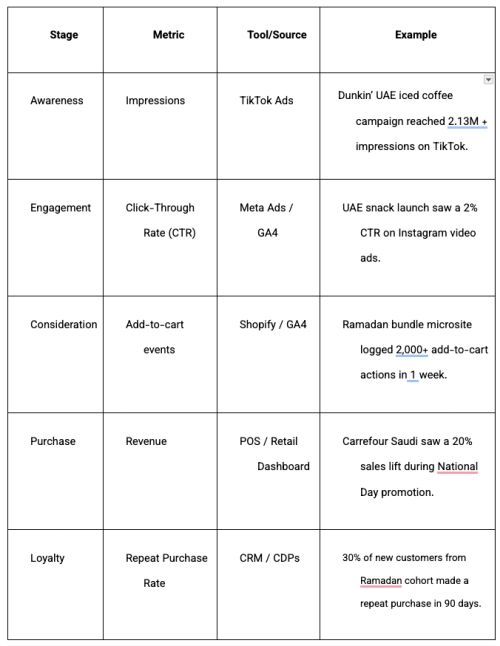
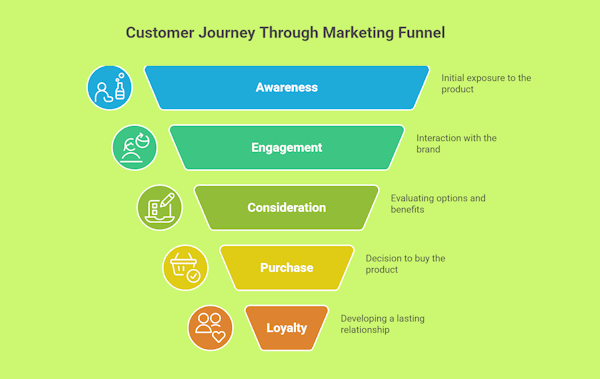
In MENA’s fast-moving consumer goods (FMCG) industry, successful regional campaigns follow a marketing funnel from Awareness to Loyalty, with key performance indicators (KPIs) at each stage. These KPIs form a “KPI tree” that helps marketing and CRM leads track campaign effectiveness and optimize strategy at every step.
Sample KPI Tree for a Regional Campaign
The table below outlines each stage of the marketing funnel - Awareness, Engagement, Consideration, Purchase, and Loyalty - along with the stage’s meaning, key performance metrics, measurement tools, and example insights or outcomes.
Awareness: Impressions & Video Views
At the top of the funnel, the goal is simple: get noticed. The awareness stage is where brands aim to maximize visibility, making sure as many relevant people as possible see their campaign.
Impressions are the baseline metric here. They tell you how often your ad or content is shown. The more impressions you generate, the more people you’re reaching. In platforms like Meta Ads and TikTok Ads, impressions are crucial for building familiarity, especially in broad, diverse markets like the UAE and KSA. A great example is Dunkin’ UAE’s iced coffee launch on TikTok, which clocked over 2.13 million impressions, putting the brand in front of a massive local audience.

But awareness isn’t just about showing up; it’s about holding attention. That’s where video views come in. Unlike impressions, views show how many people actually stuck around to watch your content, even if it’s just a few seconds. This is a powerful signal of early engagement, especially in video-loving MENA markets like Saudi and the UAE. Take Arla Foods, for example. Their TikTok launch in Saudi Arabia didn’t just get seen; it went viral, pulling in 3.8 million video views, reaching 1.8 million people, and driving real-world demand. Shelves were cleared within days as consumers rushed to find the product. That's awareness turning into action.
Engagement: Click-Through Rate (CTR) & Time on Page
Once you've captured attention, the next step is seeing whether people actually care. That’s what the Engagement stage is all about, figuring out if your audience is just scrolling past or actually leaning in.
Click-Through Rate (CTR) is your first pulse check. It tells you how many people clicked your ad or link after seeing it. A high CTR means your creative is working; it’s relevant, persuasive, or just plain interesting.
Time on Page takes it further. It’s not just about clicking. It is about sticking. If visitors spend 90 seconds reading a landing page instead of bouncing after 15, that tells you your content is relevant and engaging. GA4 and Firebase track this. One hypermarket in MENA, for instance, promoted a new cereal with a blog post called “5 Best Breakfasts.” Firebase showed that users coming from the campaign spent about 2 minutes on the article; clear proof the content was meaningful. That’s the kind of signal marketers look for: Are people taking time to explore, or are we losing them too soon?

Ultimately, CTR and Time on Page help you understand whether your message is just visible or genuinely compelling. If either one is weak, you don’t need more budget. You need better connection.
Consideration : Add-to-Cart & Coupon Downloads
At the Consideration stage, your audience isn’t just passively browsing; they’re showing clear signs they’re interested in buying. Whether they’re adding products to their cart or grabbing a coupon for later, these are meaningful signals that they’re close to converting.
Add-to-Cart
When a shopper adds your product to their cart, they’re a click away from purchase. It’s one of the strongest signals of buying intent in e-commerce. But it’s also where many shoppers drop off, maybe due to unexpected costs or friction at checkout.
Tracking add-to-cart events helps brands spot where that drop-off happens, and fix it. For instance, if 1,000 shoppers add a new drink to their cart but only 500 check out, there’s clearly something blocking the sale. It might be price hesitation, or maybe the checkout flow needs streamlining.
Coupon Downloads
When a shopper downloads a coupon (whether it's a 20% off code or a digital voucher in a loyalty app), they’re signaling that they plan to buy. Maybe not now, but soon. This makes coupons a powerful tool for measuring intent in the Consideration phase, especially around promotion-heavy periods like Ramadan or White Friday.
For instance, A KSA-based FMCG brand ran an influencer campaign where a TikTok creator demoed a new energy drink and shared a unique discount code. The brand’s CRM later showed that hundreds of consumers used the code on their site, clear proof that the influencer strategy converted intent into action.
Purchase: Revenue & Customer Acquisition Cost (CAC)
This is the bottom of the funnel, where all your effort needs to convert into measurable business results. The focus here is on sales outcomes and efficiency.
Revenue
Revenue is the ultimate proof that a campaign worked. It’s the total value of products sold during the campaign period , whether from in-store promotions, digital ads, or e-commerce channels.
Online, the same principle applies. During Noon’s White Friday event, brands often see massive traffic and a surge in transactions. For an FMCG brand participating in the campaign, revenue data from Noon’s seller dashboard might show, say, AED 400,000 in sales across the event, clearly tying media and marketplace activation to business results.
Customer Acquisition Cost (CAC)
CAC tells you how much you spent, on average, to acquire each new customer. If you spent AED 370,000 and brought in 5,000 new customers, your CAC is AED 74. That number becomes powerful when compared to your benchmarks or the customer’s potential value.
CAC also helps with channel decisions. If Meta ads are acquiring customers at AED 50 and TikTok at AED 90, you might shift budget accordingly, or work on boosting TikTok performance.
Loyalty: LTV, Repeat Purchase Rate & Churn
Once a customer buys, the real question is: will they come back? The loyalty stage is all about turning first-time buyers into long-term, high-value customers. In MENA’s competitive FMCG space, that means using tools like CRMs, loyalty programs, and CDPs to track and grow customer value over time.
Customer Lifetime Value (LTV)
LTV is the total value a customer brings over their entire relationship with your brand. If someone buys AED 50 of dairy products monthly and stays active for 2 years, their LTV is AED 1,200.
LTV also gives context to CAC. If you spent AED 80 to acquire a customer whose LTV is AED 300, you’re doing well. But if the LTV is only AED 60, it’s time to rethink targeting or product retention.
Repeat Purchase Rate
This metric shows how many customers come back after buying once. It’s a clear signal of satisfaction and brand stickiness.
For example, a beverage brand in KSA runs a summer campaign. Two months later, CRM data shows that 30% of new customers have made another purchase, and 15% have bought three times. That’s strong momentum, and a green light to re-engage those buyers with loyalty offers or seasonal bundles.
Churn
Churn is the flip side. It tells you how many customers you lost. For FMCG, churn might mean someone tried your product once and never came back.
Imagine an online snack shop in the Middle East. They see 5% monthly churn in their customer base. By adding post-purchase emails, WhatsApp recipe tips, or refill reminders, they reduce churn to 3%. That 2% improvement means thousands in retained revenue over time.
Align KPIs With Business Impact
This section explains how FMCG brands in MENA can align their KPIs with real business impact, focusing on profitability and true campaign effectiveness rather than just surface-level metrics.
- Profitability vs ROAS: Don’t focus on ROAS alone. As analyses show, ROAS (revenue per ad dollar) can be misleading if product margins differ. A campaign selling low-margin items might show high ROAS but still lose money, while a moderate ROAS on high-margin products can be more profitable. Instead, focus on net profit or contribution margin per segment, like profit per order or LTV to CAC.
- Incrementality vs Last-Touch: Use experimental or multi-touch approaches to measure real impact. Traditional last-click attribution ignores earlier efforts. For instance, if one campaign drives awareness and another drives conversions, a last-click model would credit all sales to the conversion ad, overstating its effect. Instead, measure incrementality through A/B tests or control groups to understand the actual lift in revenue or conversions from each campaign.
How Lamana Builds Data-Driven Campaign Foundations
At Lamana, data powers every stage of a campaign, connecting channels, audiences, and outcomes. Here's how we build integrated, performance-driven systems tailored for MENA's FMCG market.
Our Integration Blueprint
Lamana takes a structured, data-first approach to building campaigns that perform from end to end:
- Discovery: Each project begins with a full audit of the brand’s digital setup and business goals. For example, with Novin Saffron, Lamana focused on expanding visibility both locally and globally, setting clear KPIs around reach and engagement to support the brand’s leap from a local Iranian favorite to an international premium product.
- Connection: Once goals are set, Lamana connects all platforms and data points into a unified system, syncing analytics, CRM, and media data. In the Mogu Mogu Iran campaign, they routed traffic to a branded landing page that drew over 250,000 visitors. By integrating tools like GA4, the team tracked how 57,000+ users interacted, measuring bounce rates (~63%) and session lengths to pinpoint interest and drop-off points.
- Activation: With everything connected, Lamana launches tailored creative across relevant platforms. For Novin Saffron, they deployed 12 native banner ads, global Google ads, and 93 culturally localized social posts. Meanwhile, Mogu Mogu’s rebrand brought its flavors to life as illustrated characters across YouTube and social media, generating 27.3 million impressions and an impressive 4.5% CTR on Google/YouTube ads.
- Measurement: Lamana monitors performance in real time through unified dashboards that track metrics across the funnel, from media and site analytics to CRM and offline sales. In one regional campaign, their team adjusted budgets and messaging live based on what was working best. This flexible, cross-channel view helps teams link performance to actual business outcomes, like conversions and store sales.

Regional Tooling Expertise
To execute truly data-driven campaigns across MENA, Lamana Digital Marketing Agency relies on regional technologies and integrations that bridge media, retail, and analytics systems.
- GA4 + BigQuery: Lamana uses GA4 combined with BigQuery to track user behavior at scale. For Novin Saffron, this setup revealed detailed insights like bounce rates and average session time, helping refine content and UX.
- Meta Conversion API (CAPI): With high social media usage in the region, Lamana implements Meta’s CAPI to track conversions even when browser cookies are blocked. This setup ensures that events like purchases or form fills are accurately linked back to campaigns, helping brands like Mogu Mogu connect Instagram ad clicks to real outcomes.
- Retail Media Integrations: Lamana also supports campaigns across platforms like Carrefour and Amazon Ads. For example, Carrefour UAE’s digital network allows brands to serve targeted ads on in-store displays and measure footfall or sales lift. Lamana builds the data bridges to capture that information and feed it back into the campaign’s analytics dashboard, letting FMCG brands see how, say, a digital coupon led to an in-store purchase within days.
Sample Result
- Novin Saffron: Lamana’s integrated campaign pushed Novin Saffron to new heights, generating over 60 million ad impressions and a 54% increase in Instagram followers in just three months. Thousands of new users visited the online store, successfully positioning the product for global audiences.
- Mogu Mogu Iran: In what was described as Iran’s most comprehensive beverage campaign, Mogu Mogu reached 20+ million people and drew 250,000+ visits to its landing page. By partnering with 88 influencers and launching a layered media plan, the campaign didn’t just boost awareness; it helped fight counterfeits in-store, reclaiming market share and reinforcing brand authenticity.
Integration Is the Real Performance Multiplier
For FMCG brands in the Middle East, the real edge doesn’t come from launching the flashiest campaign or spending the most. It comes from stitching your data together, across media, website, app, CRM, and retail. When every channel speaks the same language and every shopper touchpoint connects, that’s when performance takes off.
Data integration marketing transforms disconnected insights into unified growth, letting brands understand exactly how media spend translates into sales.
You don’t need more media. You need more connected data.
If you're ready to build a scalable, privacy-first data spine that ties it all together, from ad click to shelf purchase to loyalty reactivation, Lamana helps MENA brands do just that.