- Spend Trends in GCC: Retail Media on the Rise
- Rapid Growth in Programmatic Investment
- Retail Media Changing the Game
- Brand Implication
- Contextual & Cookieless Targeting Will Rule
- The Cookie Is Dying. Now What?
- Rise of Contextual, Predictive, and First-Party Audiences
- Brand Takeaway
- Local Inventory & Premium Publishers
- The Demand for Local, Brand-Safe Inventory
- Who’s Who in MENA Publishing?
- Recommended Action
- Brand Safety, Suitability & Arabic Creative Execution
- Rising Sensitivity to Environment
- Arabic-Language Creative Challenges
- Fast Fixes
- Measurement: Beyond Clicks to Outcomes
- The New Metrics That Matter
- 1. Attention (Time in View, Engagement Depth)
- 2. Viewability (MRC Standards, Device Benchmarks)
- 3. Outcomes (Lift, Store Traffic, Omnichannel Attribution)
- Programmatic + Retail Data = Full-Funnel Visibility
- What to Do Next?
- Preparing Your Tech & Teams for the Future
- Stack Readiness
- 1. First-party audience uploads
- 2. Arabic creative optimization
- 3. Contextual signals
- 4. Connect your CDP or CRM to activation layers
- Partner Model
- MENA Programmatic Is Going Premium, Predictive, and Local
In this article, we break down how programmatic in the Gulf is evolving and what brands must prepare for; From the rise of retail media and first-party data to stronger attention metrics and culturally aware execution. he next phase of programmatic in the UAE and programmatic in Saudi Arabia will be more contextual, more measurable, and more local than ever.
Spend Trends in GCC: Retail Media on the Rise
The Gulf’s digital ad market is entering a new phase where programmatic growth and retail media expansion are reshaping how brands reach consumers. As spending accelerates across KSA and the UAE, retail ecosystems are becoming just as important as traditional digital platforms in the path to purchase.
Rapid Growth in Programmatic Investment
Programmatic ad budgets in the GCC are proliferating. BYYD reports that advertisers in Saudi Arabia spent $1.4 billion on programmatic last year, a 12.7% jump, while the United Arab Emirates (UAE) hit $796 million, up 10.2%. Programmatic KSA now makes up about 80% of digital ad spend, and programmatic UAE is close behind at 71%, showing just how fast automated buying is taking over in the region.
The main formats driving this growth are video, mobile, and digital out-of-home (DOOH):
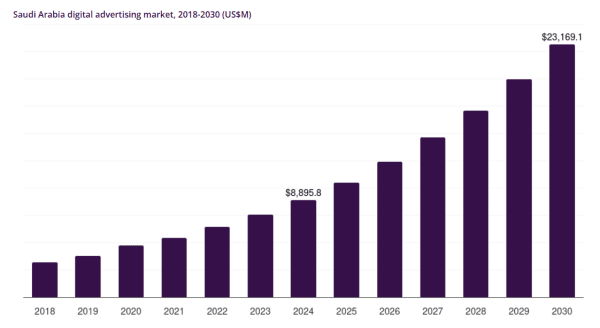
- Mobile: Smartphone ads now take the largest share of digital budgets. With over 94% of GCC internet users accessing online via mobile, mobile display and video spending continues to surge. According to BYYD and GrandviewResearch, in early 2024, the UAE alone invested $213 million in digital video advertising, ranking third after display and search. The result is shown in the chart below.
- Video/Streaming: Short-form and CTV ads are growing fast. Streaming platforms are expected to increase ad revenue by 25.8% next year, according to Campaignme. This means prompting brands to shift more budget toward online video. Even non-video spend is moving, with streaming and search showing double-digit growth according to WPP forecasts.
- Digital OOH: Out-of-home in Saudi Arabia is almost entirely digital, with 90% of the OOH budget now on digital screens. Campaignme also says that the MENA DOOH market is projected to reach $391 million by 2025, growing at a 16.4% CAGR through 2030. While currently only around 2% of GCC DOOH spend is programmatic, programmatic DOOH budgets are rising, with WPP forecasting a potential $100 million by 2030.
Retail Media Changing the Game
Retail media is a significant force in the Gulf after years of being overlooked. Supermarkets and online marketplaces are now building advertising platforms that let brands reach shoppers inside the retail journey, both in-store and online. In the following, two examples are explained.
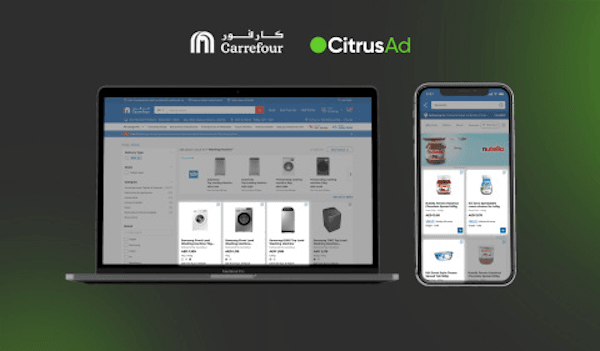
- Carrefour Precision Media: One of the strongest examples is Carrefour Precision Media, operated by Majid Al Futtaim. According to BusinessWire, the company has launched a retail media network using CitrusAd and Adform technology. This allows consumer goods brands to run sponsored product units and digital display ads at the exact moment shoppers are making decisions in Carrefour stores and on the Carrefour website. The CitrusAd system uses Carrefour’s first-party data so brands can personalize offers and monitor performance in real time through clear dashboards. Majid Al Futtaim describes this as giving brands direct access to valuable shopper insights in a fully connected retail environment.
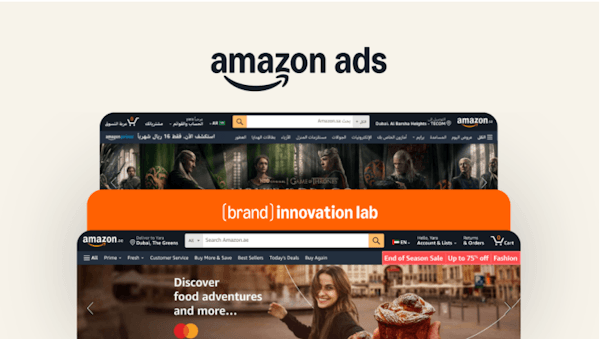
- Amazon DSP in KSA/UAE: Amazon DSP has also entered the Saudi and UAE markets. Amazon Ads confirmed that its demand-side platform now supports both countries. Campaign Middle East reports that Mastercard used Amazon DSP for a recent campaign in the UAE, combining DSP activity with prominent placements on Amazon AE. OSN Plus also activated Amazon SA by launching a House of Dragon brand store and using Amazon delivery boxes with QR codes to drive audiences to the platform. These cases show that brands can use Amazon DSP even if they do not sell on Amazon, reaching shoppers through display, and video placements across Amazon AE,

- Noon Retail Media (UAE & KSA): Noon has quickly become one of the region’s most important retail media platforms. With strong traction in both the UAE and Saudi Arabia, it gives brands access to sponsored listings, targeted display units, and promotional placements, particularly in its heavily trafficked grocery section. Its shopper data and country-specific structures make it a key environment for FMCG, electronics, and lifestyle brands aiming to influence purchase decisions directly at the digital shelf.
- LuLu Hypermarket Retail Media: LuLu is another major GCC retailer investing heavily in retail media. Operating across several Gulf markets, LuLu offers brands a wide range of digital placements across its website and mobile app, backed by strong loyalty and purchase-behavior data. For international brands entering the region, LuLu provides immediate access to high-intent shoppers _ covering everything from everyday grocery needs to higher-value basket categories.
Brand Implication
The rise of retail media means brands can no longer rely only on Facebook or Google. As noted in the WPP forecast shared by Campaignme, the rapid rise of retail media requires full-funnel and omnichannel planning. Google’s latest Search Ads 360 update, mentioned in the Blog.Google, even supports offsite retail media by combining retailer first-party audiences with Performance Max.
Contextual signals are also gaining importance, supported by insights from BrandmoTech. To stay competitive, brands in KSA and the UAE need to integrate retail ecosystems such as Carrefour, Noon and Amazon into their programmatic strategies to achieve a more complete and measurable presence across the full path to purchase.
Contextual & Cookieless Targeting Will Rule
As cookies become less effective and privacy regulations tighten, traditional targeting strategies in MENA are struggling. To effectively reach Arabic-speaking audiences while maintaining relevance and cultural sensitivity, programmatic UAE strategies now lean on contextual advertising, predictive models, and first-party data.
The Cookie Is Dying. Now What?
Looks like third-party cookies are finally heading out, even if the timelines keep changing. Google’s now saying early 2025 for Chrome, while Safari and Firefox have already been blocking most trackers by default for a while. Redcloveradvisors states that Apple’s App Tracking Transparency has pushed iOS opt-in rates from around 70% to nearly 10%. With these changes, cookie-based IDs have lost reliability, and analysts consistently point toward first-party data and contextual targeting as the durable alternatives.
The technical reality reflects this shift. According to Novatiq, cookie match rates sit at just 30-45%, which means leaving large audience gaps. In Arabic media, the problem is even sharper. A Seedtag/OMG study found that contextual ads placed within Arabic-language content generated about 3.5× more attention than standard formats, according to.
We are seeing the same trend across MENA publishers; identity matching remains a challenge, but contextual ads are delivering real results. It’s no wonder the industry is leaning hard into contextual targeting MENA strategies as the most reliable way forward.

Rise of Contextual, Predictive, and First-Party Audiences
As cookies lose relevance in the Gulf, targeting is shifting toward context, prediction and the brand’s own first-party data.
- Contextual platforms expanding in MENA: Platforms like Seedtag and GumGum are expanding in the region. Seedtag’s Arabic-focused contextual engine proves the value of language-aware targeting—eye-tracking studies show its in-image ads on Arabic pages grab over three times more attention than typical formats. GumGum’s contextual categories are now integrated into the Basis DSP, enabling bids based on page topic, sentiment, or mood.
- First-party data becoming the new programmatic fuel: CRM and app data have become the backbone of modern targeting. With CDPs pulling in data from across CRM systems, apps, websites, and emails, brands can now push hashed user profiles straight into DSPs, making targeting both precise and privacy-compliant.
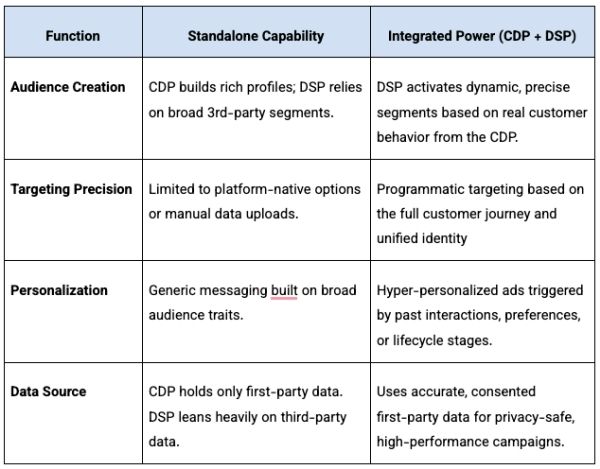
- CDP integrations with DSPs: The CDP → DSP workflow - taking hashed emails/device IDs from CRM and activating them in campaigns - is considered a foundational cookieless strategy, delivering higher ROI than legacy third-party segments. The table below, taken from ConsultTV, summarizes how CDPs and DSPs operate on their ownو and why integrating them creates exponentially stronger targeting, personalization, and privacy-safe performance.
Brand Takeaway
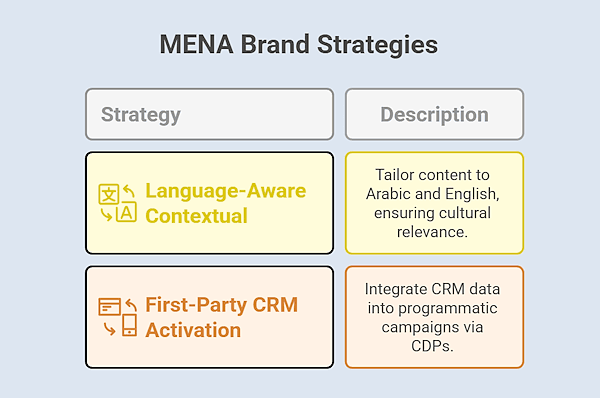
To succeed in MENA, brands need to blend culturally aware, language-specific strategies with contextual targeting in MENA and first-party CRM data to reach the right people, without relying on cookies.
- Build language-aware contextual strategies: MENA audiences consume content in multiple languages, primarily Arabic and English, therefore contextual strategies need to reflect this behavior. Training models on Arabic content makes a real difference when targeting markets like Saudi Arabia or Egypt. Seedtag’s data shows that ads which are placed in Arabic contexts perform noticeably better than generic ones. To get it right, brands should build separate campaigns or keyword lists for each language and region, and take the time to review every placement for cultural fit and brand safety.
- Activate allowed first-party CRM segments into DSPs: At the same time, first-party CRM and loyalty data should be integrated into programmatic campaigns via CDPs. By uploading hashed and consented customer lists into DSPs, brands can create people-based segments that bypass cookies, enabling highly exact targeting and personalization. Linking your CDP, DSP, and CRM helps your data flow safely into campaigns. It’s an easy, privacy-friendly way to reach real people across KSA, the United Arab Emirates, and the wider MENA region.
Local Inventory & Premium Publishers
Arabic-language inventory in KSA and UAE is scarce but highly sought after, driving premium CPMs. Top publishers like Gulf News, Al Arabiya, Al Khaleej, Sabq, and Akhbaar 24 lead the way, alongside niche sites in lifestyle, business, food, and sports. To get quality placements, brands should work with trusted SSPs and blend Programmatic Guaranteed with PMP deals.
The Demand for Local, Brand-Safe Inventory
The Arabic-language inventory is becoming a top priority for GCC advertisers. According to Adgully, with roughly 420 million Arabic speakers worldwide, campaigns in Arabic often outperform English ones in engagement and click-through rates.
Governments and brands in the UAE and KSA are pushing hard for “Arabic-first” strategies, but with just 5% of online content in Arabic, quality local inventory is scarce and comes at a premium.
To maintain brand safety, marketers increasingly rely on vetted premium publishers. Programmatic curation via private deals allows advertisers to prioritize quality, relevance, and brand-safe placements in MENA.
Who’s Who in MENA Publishing?
Leading publishers in the Gulf include Gulf News (UAE), Al Khaleej (UAE), Al Arabiya (Saudi/UAE), and Saudi portals Sabq and Akhbaar24. Vertical sites in lifestyle, business, food, and sports, such as Lovin Dubai, StepFeed, Arabian Business, and Sport360, also attract loyal audiences, giving brands diverse and culturally relevant platforms to reach MENA consumers.
General news publishers include:
- Gulf News (UAE): Leading English daily with ~650K unique users and ~7 million monthly pageviews (advertising.gulfnews.com).
- Al Khaleej (UAE): Popular Arabic-language daily from Sharjah (Wikipedia).
Al Arabiya (Saudi/UAE): Pan-Arab news channel with a strong regional following (Wikipedia).
- Sabq & Akhbaar24 (Saudi Arabia): Top online news portals delivering local coverage.
Vertical and niche publishers also attract loyal audiences: lifestyle sites (Lovin Dubai, StepFeed), business media (Arabian Business, Gulf Business, Forbes Middle East), food blogs (Foodiva), and sports platforms (Sport360, Yalla Kora). According to Augustusmedia, Lovin Media alone reaches 28 million monthly users and 10.2 million social followers.

Recommended Action
GCC brands should lock in quality Arabic inventory through trusted supply partners and private deals that offer transparency, brand safety and reliable access to top placements.
- Use trusted SSPs with local integrations: Partner with platforms directly connected to UAE/KSA publishers to ensure transparency and brand safety.
- Leverage Programmatic Guaranteed + PMP deals: Lock in premium inventory with private deals - PG and PMP setups offer guaranteed impressions, clear pricing, and access to top-tier sites. Blending both gives marketers the scale they need without losing control, particularly when targeting high-demand Arabic content.
Brand Safety, Suitability & Arabic Creative Execution
Brands in KSA and UAE put a premium on safe ad placements, steering clear of sensitive areas like religion, politics, and gender. Arabic creative also needs thoughtful localization - from typography to culturally on-point CTAs. Fast wins? Use pre-bid brand safety tools, dynamic creative tech, and native Arabic talent from the start.
Rising Sensitivity to Environment
Brands in the Middle East are becoming far more selective about where their ads appear. As mFilterIt notes, people judge both the message and the environment around it, so ads placed next to culturally unsafe or offensive content damage trust. According to Integralads, Global research backs this up: 82 percent of consumers say ad context matters.
Because cultural norms vary across the region, what feels totally neutral in one country may be inappropriate in another. Analyses point out that imagery or references acceptable in one MENA market may be viewed as insensitive in another due to religious or cultural expectations.
This is why advertisers in the region often apply both global frameworks (like GARM and IAB standards) and local filters to avoid sensitive topics such as religion, politics, or gender. In practice, marketers now rely on keyword blocking, contextual classification, and pre- or post-bid filters to keep ads away from unsuitable content.
Arabic-Language Creative Challenges
Beyond safe placement, Arabic creative quality is a major differentiator. Many campaigns still begin with English concepts and only bring in Arabic writers at the last step.
- Poor localization & cultural mistakes: Many international campaigns treat Arabic assets as secondary, handing translation to non-native teams. This often results in weak or even offensive creativity. One example that got a lot of backlash was a Ramadan ad showing a crescent moon on a shoe; a serious cultural misstep, since the sole of a shoe is seen as impure in many Arab societies. It’s a clear reminder of what can go wrong when English-first ideas are reused without proper cultural understanding.
- Weak or mistranslated copywriting: In many cases, Arabic copywriters are looped in way too late - usually just to translate the final script. That approach often leads to flat, generic messaging that misses the mark with Gulf audiences. You really can’t just take an English idea and tweak the language; without culturally grounded thinking from the start, the creative simply doesn’t connect.
A standout example of culturally grounded ideation is Lamana’s campaign ‘When Your Cheeks Smile, You Know It’s Right’, which brought emotional tone and Arabic-first messaging together through expressive visuals and locally resonant phrasing. The campaign sidestepped typical translation issues by starting with local insight, humor, and emotion; a clear example of how authentic Arabic storytelling drives deeper engagement in Gulf markets.
- Right-to-left (RTL) typography challenges: Arabic is written right-to-left and has a calligraphic flow, so fonts, letter-joining, spacing, and diacritics need careful handling. Designers cannot just flip layouts for Arabic. They often need to tweak font sizes, adjust spacing, and even restructure the whole template to keep things clear and visually balanced.
- Phrasing and calls-to-action (CTAs): Arabic ads frequently underperform when CTAs are missing, unclear, or poorly translated. PPC audits show that Arabic search ads without direct CTAs (e.g., “ احجز الآن - Book Now” or “تسوق اليوم - Shop Today”) confuse users and reduce click-through. Matching headlines, keywords, and CTAs in Arabic is essential to avoid wasted spend and irrelevant clicks.
The video below shows exactly how these mistakes play out in real campaigns.

Fast Fixes
To quickly strengthen both brand safety and Arabic creative quality, Gulf advertisers can rely on a mix of smart ad-verification tools, dynamic creative automation, native cultural expertise, and continuous testing to keep campaigns aligned with local norms and performance goals.
- Use pre-bid brand-safety tools: Solutions like IAS and DoubleVerify help block unsafe placements before bidding. Regional publishers already use these pre-bid filters to deliver brand-safe environments, while advertisers add custom keyword blocks and post-bid tags for additional protection.
- Adopt dynamic creative platforms: Tools like Smartly and Ad-Lib let teams quickly build and localize Arabic creatives, run A/B tests and also automate variations across channels. These platforms make use of machine learning to identify which elements perform best, and brands report up to 60 percent lower production costs compared to manual workflows.
- Involve native Arabic talent early: Arabic copywriters and designers bring cultural nuance that translations alone cannot capture. Experts stress that effective Arabic campaigns come from creatives who understand local traditions, symbolism, and etiquette. Including them from the start reduces risk and improves cultural fit.
- Maintain ongoing QA and testing: Creativity isn’t a one-and-done magic trick. Even the strongest ideas need to be poked, prodded, and tested as they move out into the world. Marketers need to experiment with CTAs, tone, and visuals and also pay close attention to how each market reacts. What clicks in the UAE might not land the same way in Saudi or Egypt. Regular testing and fine-tuning isn’t just a nice-to-have; it’s key to staying relevant and culturally on point.
Measurement: Beyond Clicks to Outcomes
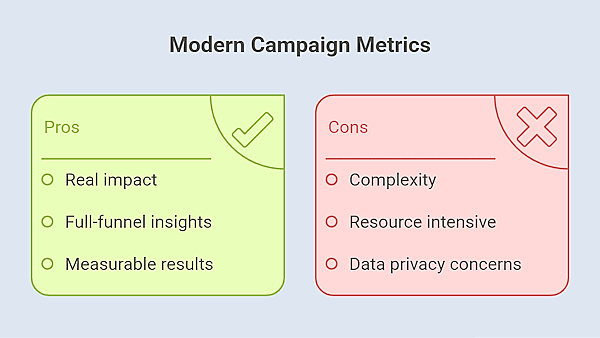
Modern campaigns measure real impact through attention, viewability, and outcomes. Full-funnel insights come from retail data, GA4, BigQuery, and conversion APIs, while incrementality tests and KPI trees make sure that every campaign drives measurable business results.
The New Metrics That Matter
As mentioned, marketers in the Gulf are shifting from surface metrics like clicks toward deeper indicators of real impact, focusing on the following aspect:
- Attention
- Viewability
- outcome
1. Attention (Time in View, Engagement Depth)
Attention has become a central metric because impressions and CTRs rarely reflect real exposure. Smartyads show that only about 20 percent of display ads are actually seen by users. That’s why more marketers are paying attention to how long people actually see an ad, and what they do while it’s on screen.
When an ad stays visible longer, it tends to stick better in people’s minds and can even drive foot traffic to stores. Engagement depth looks at actions such as scrolling, video plays and hovers, giving a clearer sense of whether a user truly paid attention instead of just glancing at the ad.
2. Viewability (MRC Standards, Device Benchmarks)
Viewability remains the baseline. According to MRC and IAB guidelines, a display ad is considered viewable when at least half of the pixels are visible for one second, and video requires two seconds at 50 percent visibility. Performance varies by placement. Desktop display averages around 72 percent viewability, mobile around 68 percent, and above-the-fold video can exceed 70 percent compared to nearly 45 percent below-the-fold. Most teams set benchmarks in the 60–70 percent range and optimize layouts to increase real-time in view.
3. Outcomes (Lift, Store Traffic, Omnichannel Attribution)
The media needs to drive real results. Lift tests and footfall tracking help show whether ads actually lead to in-store visits or sales, not just clicks. Retail case studies show how effective this can be; Carrefour, for example, reports that about 20 percent of its store sales are driven by digital campaigns. Omnichannel attribution and media-mix models combine CRM, loyalty, web analytics and POS data to reveal which touchpoints actually influence sales or incremental ROI instead of relying on simple click-based metrics.
Programmatic + Retail Data = Full-Funnel Visibility
DSPs are now integrating retailer transaction data so campaigns can optimize toward real purchases. According to Theoutcome, the Trade Desk’s partnership with Attain, for example, feeds near-real-time POS sales into the platform, giving advertisers direct “sales signals” for planning, activation, and optimization. This allows bidding strategies to focus on revenue rather than proxy metrics like CTR. Marketers can even build lookalike audiences based on verified buyers.
Carrefour’s retail media network links loyalty and POS data in privacy-safe clean rooms, letting brands directly tie campaigns to in-store sales. About 20% of their sales now trace back to digital ads, which is clear proof of real impact.
Marketers also use analytics tools like GA4 and BigQuery alongside Conversion APIs to merge web events, CRM records and offline sales. Meta’s Conversions API and tools like Attain feed offline sales back into DSPs, helping optimize for purchases and LTV. When combined with GA4, BigQuery, and clean-room data, brands can track the full path from ad view to checkout.
In Lamana’s “When Mogu Mogu Turned Flavors into Personalities” campaign, product storytelling was brought to life through character-based creative and multichannel distribution, showing how FMCG brands can use retail-facing assets to blend emotional engagement with performance-driven placements across the path to purchase.
What to Do Next?
Teams now need to prove true incremental impact by running structured lift tests and using KPI trees that link every stage of the funnel - from awareness to LT - to measurable business outcomes.
- Emphasize incrementality: Brands should move beyond last-click attribution by running controlled tests, such as geo-based holdouts, to measure the true lift generated by advertising. This approach isolates net-new conversions instead of crediting sales that would have occurred anyway. Around 71 percent of marketers now consider incrementality their top KPI for retail media.
- Use KPI trees for campaign planning: Mapping metrics to each stage of the funnel keeps teams aligned. Awareness efforts focus on reach, viewability and attention. Engagement KPIs look at video completion, scroll depth or time-in-view. Conversion KPIs include purchase lift or sign-ups, while LTV tracks repeat buyers and customer value. This structure ensures every metric supports long-term business outcomes rather than optimizing for vanity metrics.

Preparing Your Tech & Teams for the Future
As programmatic evolves in the Gulf, brands need a tech stack that supports first-party data and Arabic workflows, along with partners and internal teams ready to manage testing, automation and measurement.
Stack Readiness
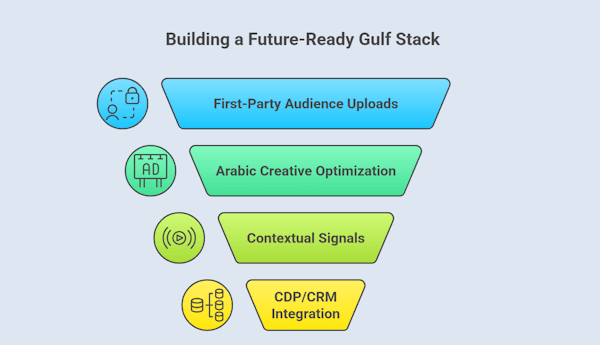
To run effective programmatic UAE and programmatic KSA campaigns, brands need tech stacks that can activate their own data, support Arabic-first creative, and use contextual signals. In the following, some requirements for a future-ready Gulf stack are mentioned briefly.
1. First-party audience uploads
Your DSP should let you upload customer or loyalty data safely and use it in your campaigns. Tools like DV360 and Amazon DSP make this easy by supporting secure first-party targeting.
2. Arabic creative optimization
Creative platforms must support right-to-left layouts and Arabic-language templates. Tools like Smartly.io and Ad-Lib provide automated Arabic versions of ads, while brands such as Coca-Cola Arabia used Google’s Creative Studio to produce multiple localized videos for Saudi audiences.
3. Contextual signals
Your stack needs to support contextual targeting; especially using Arabic content cues as a cookieless alternative. Tools like Seedtag and GumGum offer MENA-specific engines designed for this.
4. Connect your CDP or CRM to activation layers
Your CDP or CRM should be integrated directly with DV360, Amazon DSP or Meta’s Conversions API so first-party segments flow automatically into campaigns. These integrations, using Salesforce, Adobe CDP and Meta CAPI, are already widely adopted across KSA and United Arab Emirates (UAE).
Partner Model
To succeed in programmatic across KSA and the UAE, brands need the right mix of local expertise and strong internal capabilities. The region’s cultural nuances, Arabic content needs and measurement maturity all mean that partnerships and team structures matter as much as the tech stack itself.
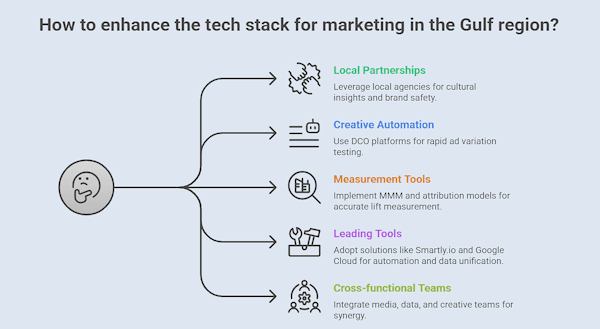
- Work with local agencies and talent: Local partners understand Arabic UX, cultural expectations and key moments like Ramadan. They help ensure ads run in “contextually relevant and brand-safe” environments and create creatives that feel native to Saudi and Emirati audiences rather than translated from English.
- Build internal skills in creative automation and data: Brands in the Gulf increasingly rely on DCO platforms such as Smartly.io and Ad-Lib to produce and test Arabic ad variations quickly. Retail and travel teams also use feed-based workflows that push real-time product data into DSPs.
- Strengthen measurement and incrementality testing: Marketers now use MMM, multi-touch attribution and geo-holdout tests to measure real lift, for example, comparing sales in a city exposed to ads versus one held out as a control.
- Adopt leading tools for creative, targeting and data: Common solutions include Smartly.io and Ad-Lib for automation, Meta’s Advantage tools and Conversions API for CRM-linked targeting, and Google Cloud + BigQuery to unify customer data before activating it in DV360.
- Run cross-functional programmatic teams: Many GCC brands now bring media, data and creative under one programmatic team while collaborating closely with local agencies that know the regional media landscape.
MENA Programmatic Is Going Premium, Predictive, and Local
Programmatic KSA and Programmatic UAE is moving in its own direction: smarter, more localized, and built for real results. As cookies fade and privacy rules tighten, brands are leaning into first-party data, Arabic-first creative, and deeper ties with platforms like Carrefour and Amazon DSP.
It’s no longer about clicks. What matters now is lift, loyalty, and store visits. In a region where cultural relevance is everything, brand-safe and Arabic-led execution isn’t just preferred, but expected.
At Lamana Agency, we help brands build future-ready programmatic strategies designed for real business outcomes in the Middle East. Let’s craft the next generation of performance, one that speaks the region’s language and delivers results that matter.